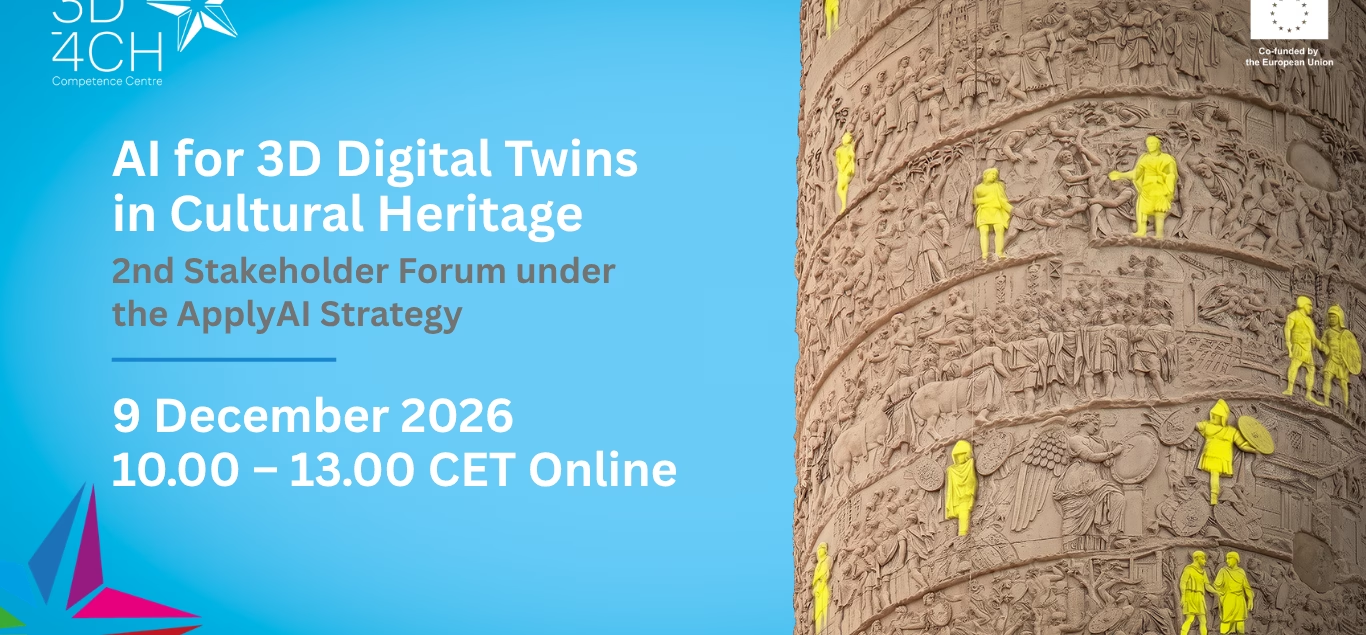
The European Commission (DG CONNECT) and the 3D-4CH Online Competence Centre invite European projects and initiatives to contribute to the second Stakeholder Forum on AI for 3D Digital Twins in Cultural Heritage, taking place online on 9 December 2026. The submission deadline is 13 November 2026.
Organised under the ApplyAI Strategy, the forum will explore how artificial intelligence can support highly realistic and accurate 3D digitisation of cultural sites and artefacts. Building on the first edition, held on 23 March 2026, the event will bring together project results and practical experiences to advance the uptake of AI in the cultural heritage sector. Projects supported through European, national or regional funding, as well as other or self-funded initiatives, are welcome to contribute.
Share Your Work Across Three Thematic Areas
The organisers are seeking approximately nine presentations of 10 minutes each, followed by five minutes of questions and discussion. Contributions should showcase results in one of three suggested areas:
- AI to support 3D digitisation: from advanced 3D capturing to generative models
AI techniques that accelerate or improve 3D surveying and data processing, enhance legacy models or scale up digitisation pipelines. This includes neural rendering methods such as Gaussian Splatting, generative AI approaches working from one or more images, and AI-driven completion of missing or damaged parts. Еspecially welcome experiences that compare these methods with traditional 3D documentation in terms of accuracy, reliability and transparency, and show where they can complement conventional surveys. - From geometry to meaning: AI for enriching and understanding 3D heritage
AI methods that complement 3D geometries with structured, searchable knowledge: 3D segmentation and classification of elements and materials, damage and condition mapping, automatic generation of metadata and paradata, and links between 3D models, ontologies and knowledge graphs, making enriched 3D data findable and reusable in the common European data space for cultural heritage. This includes supervised and unsupervised methods, multimodal and vision-language models to describe or query 3D assets, annotated training datasets and expert-in-the-loop validation. - AI for data visualisation, interpretation, narrative creation and reuse
AI approaches that analyse, visualise or interpret cultural heritage data and scenes, support decision-making in conservation and management, and enable reuse and new narratives in education, tourism and the creative industries (for example conversational guides, generative storytelling, immersive and XR experiences, predictive models for monitoring), while keeping AI-generated interpretation distinguishable from documented evidence.
Additional AI-related topics relevant to 3D cultural heritage are also welcome, even if they do not fully align with the three suggested themes.
New voices and new results
This second edition aims to widen the range of projects and speakers represented. Priority will be given to projects, initiatives and speakers that did not present at the March 2026 forum. Those who presented in March are welcome to apply again if they can report significant new results obtained since then, and should describe them briefly in their submission.
Visit the invitation page on the 3D-4CH Online Competence Centre for submission details. Submit your contribution by 13 November 2026 to share your results with the European 3D cultural heritage community.
The project “3D-4CH – Online 3D Competence Center for Cultural Heritage” is implemented in Ukraine by the Pixelated Realities PO, a partner of the 3D-4CH consortium, and co-financed by the European Commission under the Digital Europe Programme. In accordance with Ukrainian legislation, the project is registered as international technical assistance, with the Ministry of Culture and Information Policy of Ukraine indicated as the beneficiary.