Pixelated Realities PO × Repox.io team: Building Scalable Infrastructure for 3D Cultural Heritage Management and European Access
The partnership between Pixelated Realities PO and TALENT ANONYMOS ETAIRIA PLIROFORIKIS S.A (Talent S.A.) grew within the framework of the 3D-4CH project, where Repox.io data management platform serves as a core infrastructure component for managing, organising, and publishing complex digital collections.
Pixelated Realities PO and Talent S.A. began working together through the 3D-4CH Competence Centre project, co-funded by the EU Commission as part of the Digital Europe programme, which brings together digitisation specialists, cultural heritage institutions, and technology providers to establish best practices and a shared learning platform for 3D competencies in the European heritage sector.
A new initiative between the organisations has been launched to populate a Repox database with information on 85 Cossack crosses in Odesa. Building on previous collaborative efforts, Pixelated Realities PO, in partnership with Repox.io, has started implementing the international project “Cross‑sectoral Platform for Research of Cossack Crosses of Odesa” with the support of the Ukrainian Cultural Foundation. The results and feedback from this collaboration will be used for updating features of the platform and preparing it for future use by Ukrainian organisations.
Why this partnership matters
The collaboration between Pixelated Realities PO and Repox.io is not simply a story of adopting a new technology platform. It takes place in a context that gives the technical work particular urgency and significance.
Ukrainian cultural heritage institutions operate under conditions that many European partners have never had to confront: the physical vulnerability of collections, the urgency of documentation where physical survival cannot be guaranteed, and the importance of establishing a presence in trusted European databases that ensure long-term visibility and international recognition.
Repox Store provides infrastructure that is flexible enough to reflect the specificity of Ukrainian heritage objects and institutional practice, rigorous enough to meet the standards required for Europeana publication, and interoperable enough to connect local collections with global audiences.
Pixelated Realities contributes field expertise, curatorial precision, and a strong understanding of what must be preserved and why.
What is Repox and how can it help manage heritage data?
Repox is a modern headless content management platform designed for integration, scalability, and collaboration. Built with a flexible architecture, it enables institutions, especially in the public and cultural heritage sectors, to organise, store, retrieve, and preserve digital assets efficiently.
This is not a generic cloud storage solution. Repox Store was designed specifically to address the challenges institutions such as Pixelated Realities face in daily work: the heterogeneity of digital assets produced through digitisation projects, the need to preserve rich metadata alongside large binary files, and the requirement to publish content in formats compatible with European aggregation pipelines and open data standards.
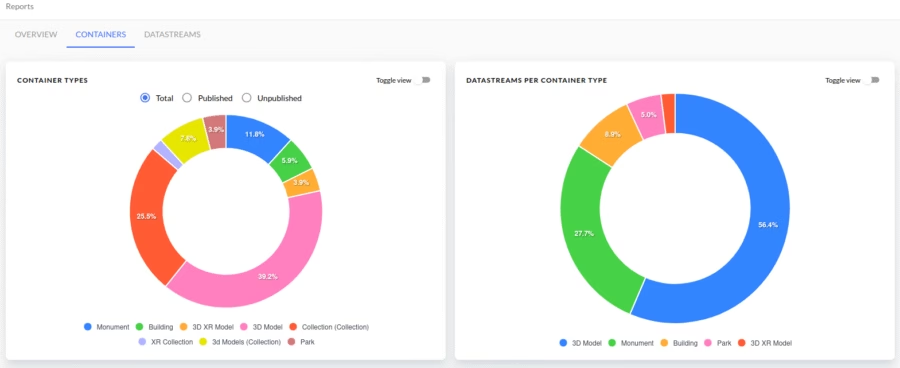
The platform currently serves more than 15 institutions, manages over 500,000 cultural heritage objects, and hosts more than 3000 three-dimensional models, demonstrating both its scalability and its practical adoption within the professional heritage community.
What Repox Store Does
A holistic information ecosystem
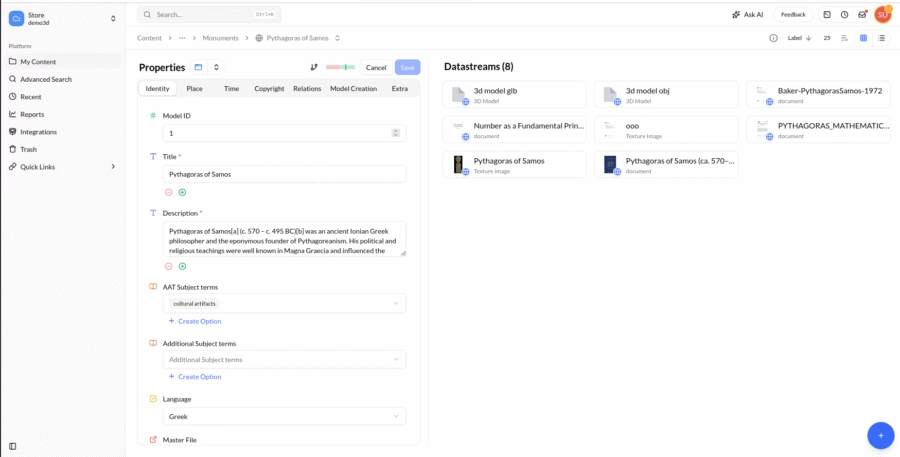
The core philosophy behind Repox Store is simple: a cultural heritage object is never just one file. In 3D digitisation projects, a single artefact, whether a carved stone cross or a porcelain cup, is represented by a bundle of interconnected data types:
- Descriptive metadata: titles, descriptions, subject classifications, geographic and temporal context, provenance information.
- Raw capture data: high-volume media files produced during scanning, including photogrammetry images, point clouds, and structured-light scan outputs.
- Processed 3D outputs: final models in different formats and levels of detail.
- Textual documentation: processing reports, methodology notes, and condition assessments.
- Supporting media: reference photographs, video documentation, and audio commentary.
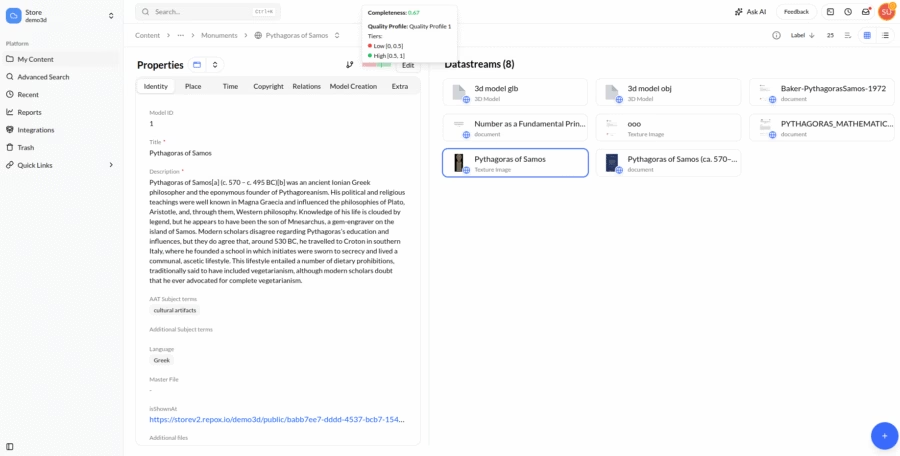
Treating the 3D model alone as the object is not enough. Repox Store brings all of these components together within a single structured content record that is searchable, traceable, and ready for publication.
Flexibility without compromise
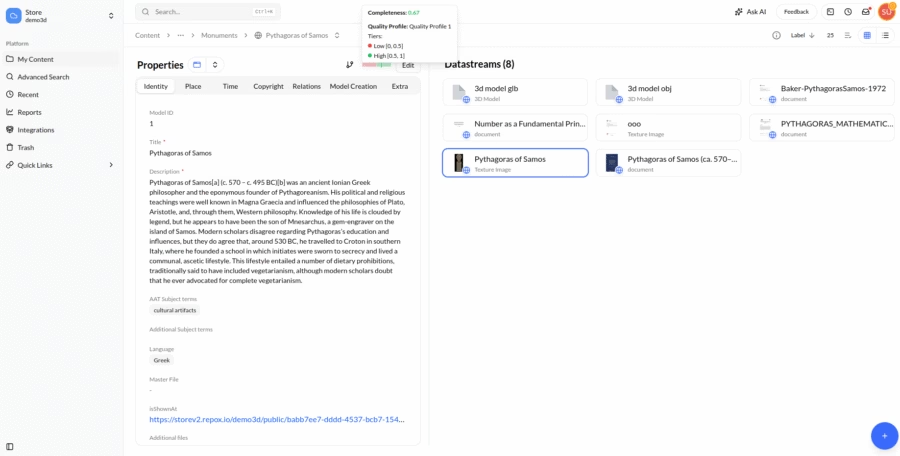
What distinguishes Repox Store from generic digital asset management systems is its commitment to institutional flexibility. The platform does not impose a predefined data model or assume that collections must be organised in one standard way. Instead, it provides a schema builder that allows institutions to define their own content types and metadata fields.
This includes a broad range of property types suited to practical collection management:
- Text / Text Area for titles, descriptions, and notes.
- Number for IDs, quantities, and ratings.
- Date for creation dates and event dates.
- Boolean for yes/no flags.
- Enumeration for categories, colours, and condition states.
- URL for links to external resources.
- Spatial for geographic coordinates.
- Rich Text for formatted descriptions with embedded media.
- Reference for links between content records.
- Vocabulary for controlled terms such as AAT, Getty, or custom lists.
- Identifier for auto-incremented or literal identifiers.
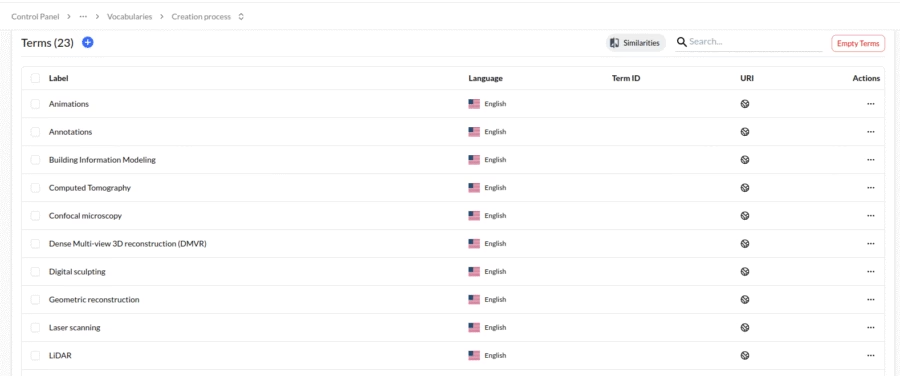
Controlled vocabularies support consistency across records. Quality profiles help track and improve metadata completeness over time. Mapping schemas and crosswalks make it possible to transform institutional data into standardised formats for external publication. In short, institutional practice defines the structure, not the system.
Ingest and organisation at scale
For institutions managing large digitisation campaigns, workflow matters as much as architecture. Repox Store supports bulk import of both files and metadata, allowing entire collections to be ingested efficiently.
The platform supports major 3D file formats, including .glb, .gltf, .fbx, .obj, .stl, .dae, and .ply, as well as materials and texture files such as .mtl, .png, and .jpeg, alongside Gaussian Splatting outputs.
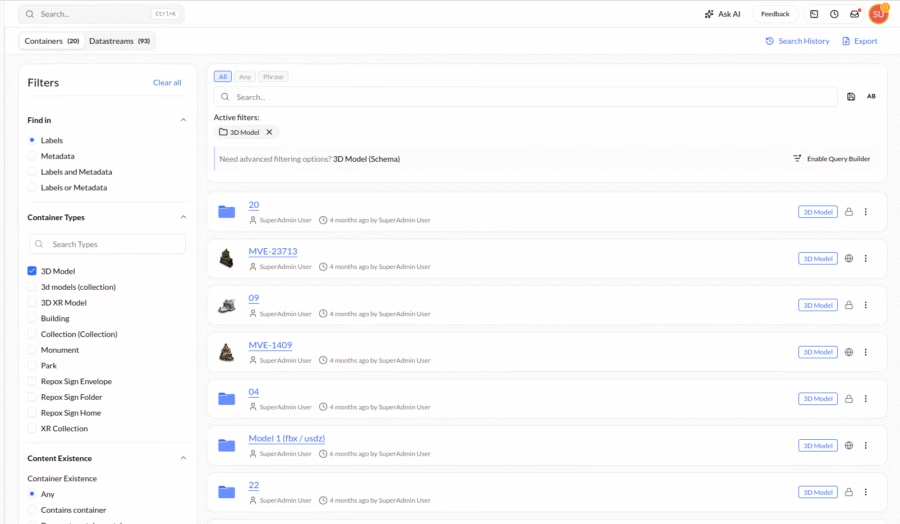
Once ingested, content becomes searchable through an advanced filter interface that supports queries by metadata schema, content type, and specific property values. For example, a query for all 3D models created through photogrammetry can return exactly that, provided the relevant metadata has been entered during ingestion.
Version control and audit trails record every modification to a content record, including what changed, who made the change, and when. Analytics provide an overview of collection growth and metadata completeness over time, which is especially useful for monitoring project progress and preparing grant reports.
The built-in 3D viewer
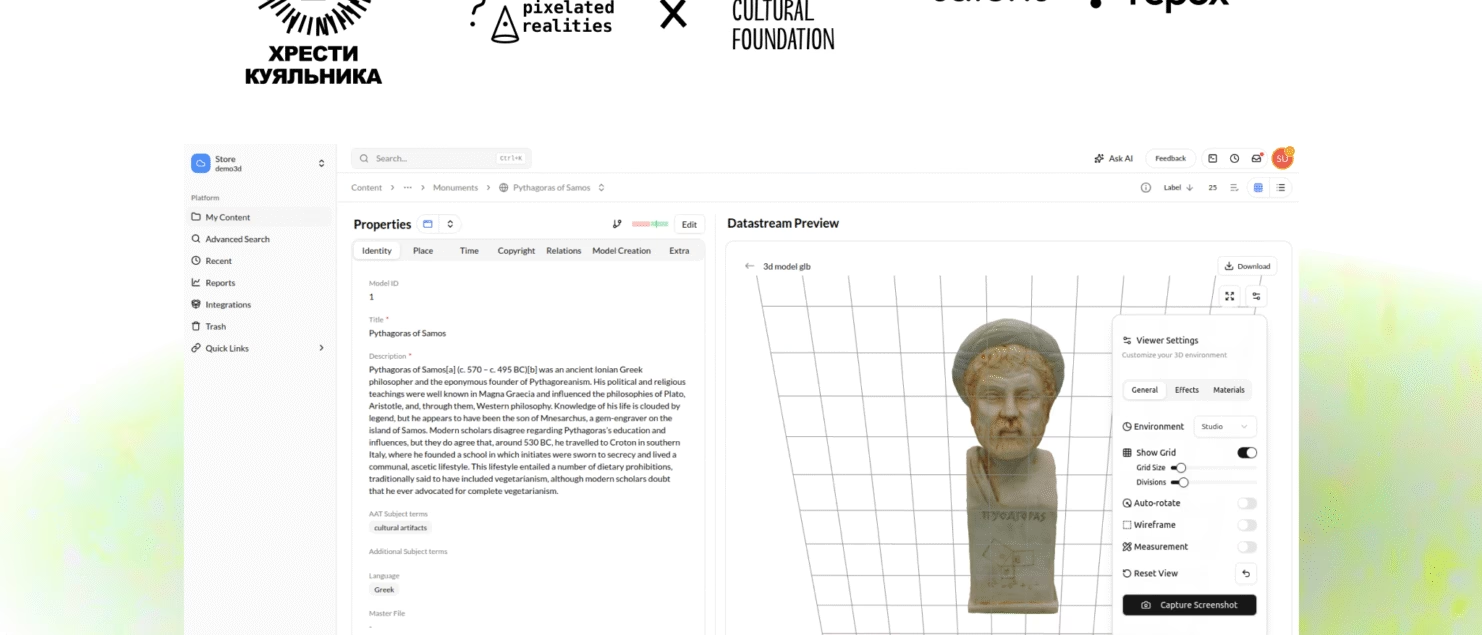
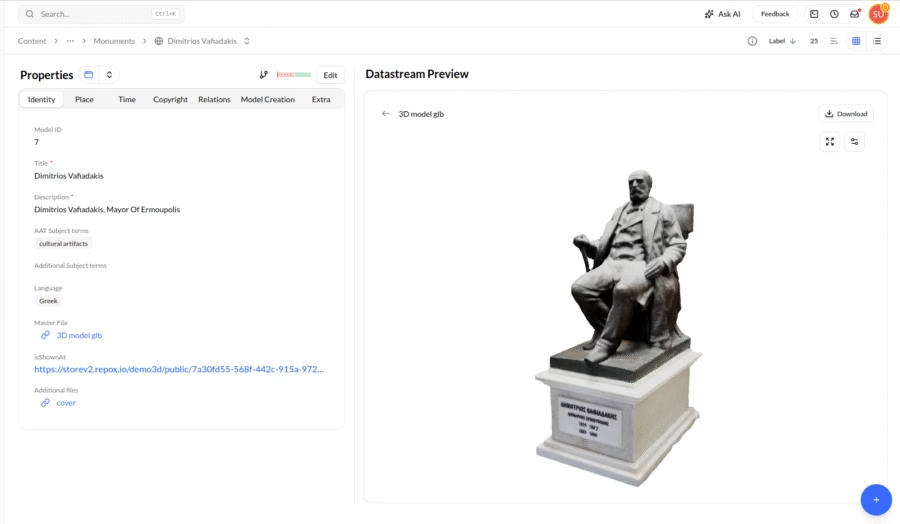
One of Repox Store’s most valuable features for digitisation-focused teams is its embedded 3D viewer (i.e. Repox 3D Viewer). Instead of exporting files to a separate application for review, team members can preview, inspect, and document 3D content directly within the platform.
The viewer includes:
- Interactive exploration through rotate, zoom, pan, and auto-rotate.
- Visualisation with materials and textures.
- Gaussian Splatting rendering.
- Configurable scenes with lighting presets, wireframe mode, and visual effects.
- A measurement tool for calculating distances within the model.
- Screenshot capture for documentation and reporting.
For teams working across multiple digitisation projects, the ability to review a model and annotate it with metadata in one interface, instead of switching between a 3D viewer, spreadsheets, and databases, significantly reduces workflow friction.
Technical foundation
For institutions making long-term infrastructure decisions, Repox Store’s technical architecture is a major strength. The platform is built on a modern open stack:
- Backend: Spring Boot (Java), headless architecture with a REST API.
- Database: PostgreSQL for structured data.
- Object storage: an S3-compatible layer that works with MinIO, AWS S3, Google Cloud Platform, and other providers.
- Search and indexing: OpenSearch.
- Async workflows: RabbitMQ.
- Web client: React-based.
Access control is granular and covers users, groups, and individual objects through IAM permissions and Access Control Lists (ACLs). Because the system follows an API-first approach, custom applications, integrations, and extensions can be built without architectural constraints.
Deployment is available in two models: SaaS, for cloud-hosted access by subscription, or on-premise, for local installation and full institutional control over data. The Repox team also provides personalised support, online documentation, and hands-on guidance for data modelling, migration, and curation, as well as custom development when needed.
Looking ahead, the platform’s AI layer, already in development, introduces a conversational search interface for querying collections in natural language, alongside AI-assisted metadata enrichment and document graph visualisation for exploring relationships within large collections.
From Repox to Europeana
Managing and preserving content is only part of the task. For the work of Pixelated Realities to reach researchers, educators, and the public, it must also be discoverable through European and international heritage platforms.
This is where Repox Store connects to the broader publication ecosystem. Through its integration with the Share3D Dashboard 2.0, developed in collaboration with CARARE within the 3D-4CH project, content managed in Repox can be ingested, metadata-enriched, and published directly to Europeana and the Common European Data Space for Cultural Heritage.
Repox Store functions as a recognised source platform within Share3D 2.0. This means that collections documented and curated in Repox can move smoothly into the European aggregation pipeline.
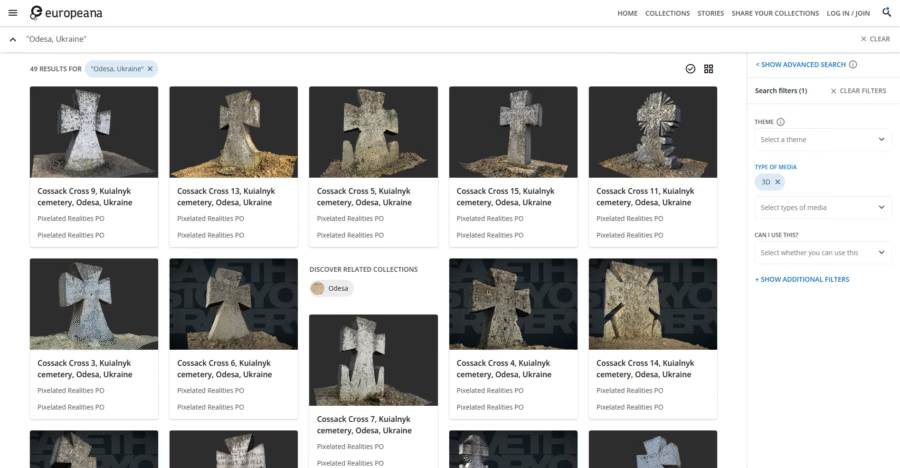
The results are already publicly visible. In Europeana’s database, under the providing institution Pixelated Realities PO, records from the organisation are now accessible to the public. Each record includes the contextual information required for meaningful discoverability: provenance, subject classifications using AAT terms, copyright statements, language metadata, and links to the 3D model itself.
These are not placeholder entries. They are complete, standards-aligned contributions to Europe’s largest cultural heritage database, produced in Ukraine, documented with precision, and made available internationally.
The international project “Cross-sectoral Platform for Research on Cossack Crosses of Odesa” is implemented by Pixelated Realities PO in partnership with TALENT ANONYMOS ETAIRIA PLIROFORIKIS S.A with the support of the Ukrainian Cultural Foundation.