Digital copies of unique jewellery will be created in Odesa
Odesa Municipal Museum Of Personal Collections Named After O. V. Bleschunov in partnership with the Pixelated Realities public organisation, will digitise 19th-century Turkmen jewellery
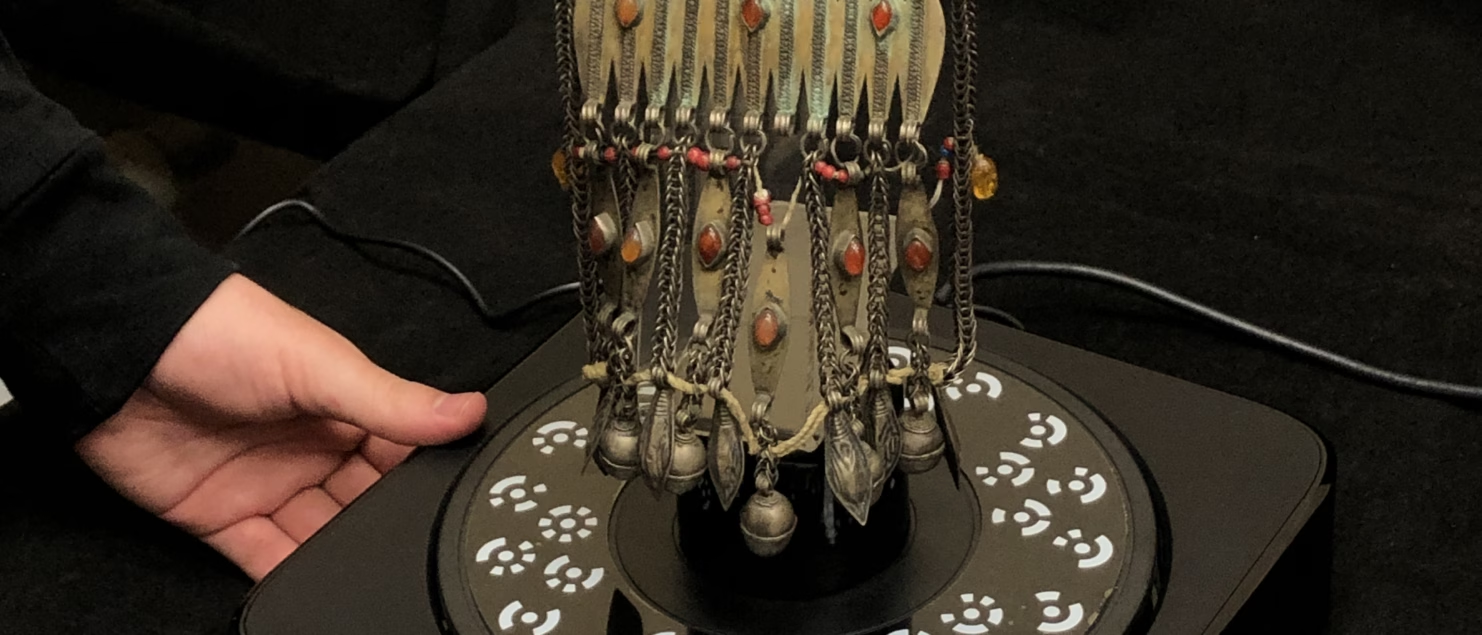
The public organisation ‘Pixelated Realities’, in partnership with the Odesa Municipal Museum of Personal Collections named after O. V. Bleschunov, is launching a project to research and digitally preserve a unique collection of 19th-century Turkmen silver jewellery, which is part of traditional women’s attire. The initiative aims to highlight the contribution of private collections and collectors to the preservation and promotion of cultural heritage, as well as to ensure the creation of a digital archive of these items within the museum catalogue.
The project will create 3D models of 32 pieces of jewellery and children’s amulets. Once completed, they will be available in the Ukrainian Museum Fund Register for researchers, students and anyone else who is interested. The project is being implemented with the support of the House of Europe programme, which promotes the digitisation of cultural heritage. Fifteen winners were selected from among 234 applications, including the OMMPC named after O. V. Bleschunov. Thanks to this, the museum was able to raise over €19,000 for the project: purchasing equipment, creating a secure digital repository, and engaging expert consultations.
Technical partnership and technologies
The optical scanner for the project was provided by the Odesa National Art Museum. The museum team and the PO Pixelated Realities exchange experience and develop new formats of cooperation for regular scanning sessions.
The technical complexity of digitising jewellery requires special attention: these are shiny, sometimes transparent objects with small details and moving parts. To achieve maximum accuracy, the team plans to use a combination of optical 3D scanning and the modern Gaussian Splatting algorithm. The optical scanner allows complex silver reliefs to be captured, while photography preserves colour accuracy. The Gaussian Splatting algorithm provides realistic visualisation of transparent materials, including gems and semi-precious stones. This approach is only just beginning to be used in the museum sector and opens up new possibilities for digital preservation.
Continuation of partnership
This is not the first time the partners have worked together. In 2024, 50 exhibits were digitised as part of the Fragile Collection project dedicated to porcelain. A particular challenge was the difficulty of photographing objects with shiny surfaces. Thanks to the introduction of cross-polarisation photography and the team’s persistence, it was possible to overcome technical limitations and create high-quality digital models.
“This process was technically challenging due to the properties of the objects themselves: porcelain has a shiny surface, which requires the use of cross-polarisation photography. The duration of processing and high requirements for scan quality created additional operational challenges for both the museum and the scanning operators,” said Fedir Boitsov, head of the PO Pixelated Realities.
Scientific significance and international perspective
The results of the project will contribute to the deeper integration of Ukrainian museums into the international research community. High-precision 3D models will allow the collection to be presented to global scientists and institutions, stimulating international exchange and the expansion of professional connections.