Ukrainian cultural heritage published in 3D on Europeana.eu for the first time
As Europeana works to support the digital cultural heritage of Ukraine and advance 3D in the common European data space for cultural heritage, we are delighted that 3D models from the Museum of Ukrainian Victory are now available on Europeana.eu.
Okhtyrka City Museum of Local Lore, Sumy region
Cultural heritage under threat in Ukraine
Making cultural heritage available for future generations to enjoy and be inspired by is a major public policy goal in the European Union. 3D technologies offer unprecedented opportunities to advance this objective, widening access to culture, supporting digital preservation and fostering the reuse of Europe’s cultural assets.
The potential of 3D models of heritage sites and objects to document, preserve and share cultural artefacts becomes even more potent when it comes to heritage at risk of destruction from climate change, natural disaster or conflict. Sadly, this is the case for the rich cultural heritage of Ukraine, which has been stolen, destroyed or displaced as a result of Russia’s full-scale invasion. As of 7 January 2026, UNESCO has verified 515 cultural sites as damaged in Ukraine, alongside thousands of cultural heritage institutions and artefacts.
The Northern Gate, Kherson city
Ukrainian 3D models on Europeana.eu
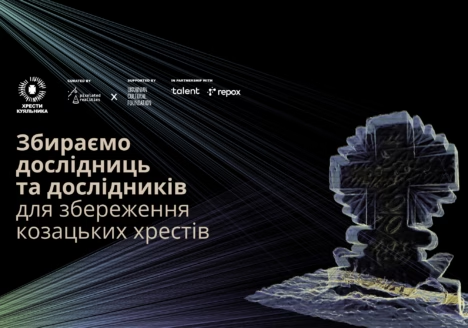
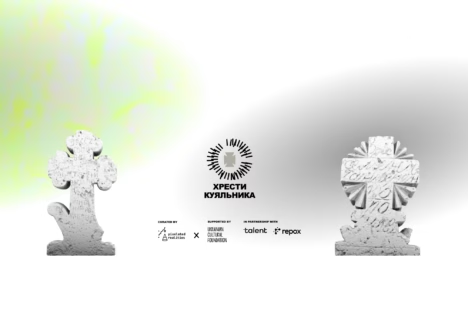
Against this background, a collaboration between Pixelated Realities, a non-governmental organisation running projects funded by the European Commission, and the EU-funded XRculture and 3D-4CH Online Competence Centre projects has seen the aggregation of the first 3D models from their Museum of Ukrainian Victory to Europeana.eu. The publication of models from the Museum enriches both the high-quality 3D data and the Ukrainian cultural heritage data which Europeana.eu makes available, and makes them available to researchers, educators, creatives and citizens over Europe.
As the 3D-4CH project explains, ‘These first published 3D models originate from the Museum of Ukrainian Victory initiative and include outdoor sculptures and heritage sites from Odesa, Kherson, Kharkiv, and Sumy regions… The cultural heritage objects were captured through emergency photogrammetry workflows conducted by trained conflict reporters with subsequent 3D processing carried out in Odesa. The models are part of a wider collection of more than 30 objects documented for the Museum of Ukrainian Victory in 2022 and early 2023.’

The Polovtsian warrior statues (Polovtsian babas)
Expert collaborators
The three initiatives involved in the publication of the models on Europeana.eu are expertly placed for this work. Pixelated Realities works to improve the methods of preserving cultural heritage, including the use of 3D scanning, digital production, virtual and augmented reality, in particular preserving Ukraine’s cultural heritage through initiatives like the Museum of Ukrainian Victory.
XRCulture uses innovative technologies to boost the availability of high-quality 3D and XR content in the data space. Targeting diverse use cases—such as preservation education and tourism—the project harnesses advanced AI tools for 3D model generation and improvement and provides an open framework for 3D visualisation.
The 3D-4CH project champions advanced 3D technologies in cultural heritage preservation and education, ensuring sustainability, accessibility and cooperation. The project has established the online Competence Centre for 3D heritage, focusing on the preservation, digitisation and knowledge transfer of cultural heritage in the EU and Ukraine.
Support from the Europeana Initiative
The Europeana Initiative is proud to be a partner in the XR-Culture and 3D-4CH projects, and to be working more widely to support the Ukrainian cultural heritage sector across the Initiative as a whole.
Speaking to the 3D-4CH project, Valentine Charles, Technical Director of the Europeana Foundation, says, ‘Together with our partners — the data space consortium, the European Commission and Member States — we are shaping the data space as the main entry point for cultural heritage data. Expanding high-quality 3D content is a priority for the years ahead. Guided by the principles of diversity and inclusion, we are committed to ensuring Ukraine’s heritage is duly represented. Building on previous work, such as the Europeana Initiative’s Supporting the digital cultural heritage of Ukraine Working Group, this step strengthens digital capacity for Ukrainian institutions while bringing 3D Ukrainian content to a wider audience.’
Sofie Taes says, ‘As Chair of the Europeana Network Association – which includes several Ukrainian members – I see these 3D initiatives as a vital expression of our ongoing connection and solidarity with Ukrainian colleagues. These models and representations allow us to jointly visit, contemplate and cherish landmarks that shape Ukrainian cultural identity, even when physical access is threatened or impossible. As Chair of Europeana’s Supporting the digital cultural heritage of Ukraine Working Group, I had the opportunity to interview Ms Anastasia Bondar (Deputy Minister for Digital Development, Digital Transformations and Digitalisation at Ukraine’s Ministry of Culture and Information Policy) at the Europeana Conference in Warsaw last year, where she underlined the strategic importance of cultural heritage and urged us not to let Ukraine’s voice be silenced. This work responds directly to that call, using powerful 3D visuals to give digital substance to a shared spirit of togetherness.’
Kerstin Arnold, Chair of the Europeana Aggregators’ Forum says, ‘One objective of our network of aggregating and data sharing services is the exchange of knowledge and expertise. This applies to the EAF’s current members, the cultural heritage institutions and professionals they work with and to other actors in the sector with the aim to support them in our shared mission of democratising access to cultural heritage and of ensuring the best data quality possible in doing so. Via the 3D-4CH project, which includes aggregators such as CARARE (Connecting Archaeology And Architecture In Europe), the European Fashion Heritage Association, the Michael Culture Association and the Netherlands Institute for Sound and Vision, we were able to focus specifically on supporting the cultural heritage sector in Ukraine and I am excited to see the first results of this work on Europeana.eu.’

The Monument to T.G. Shevchenko, Kharkiv
Looking to the future
The 3D-4CH project outlines how, ‘Building on this successful pilot, Pixelated Realities – partner of the 3D-4CH Online Competence Centre – will contribute approximately 40 additional 3D models to Europeana this year. An open call will further invite Ukrainian cultural heritage institutions to share existing 3D assets via Europeana, expanding the representation of Ukrainian heritage within international digital infrastructures… This effort is also an important step toward the long-term plans to establish a national Europeana aggregator based on the Register of the Museum Fund of Ukraine. This aggregator will serve as a key national hub, connecting Ukrainian museum collections more directly with European digital platforms and infrastructures.’Explore the Ukrainian 3D models on Europeana.eu and learn more about the work of Pixelated Realities. We also invite you to explore how Europeana is supporting the digital cultural heritage of Ukraine through its dedicated Working Group and increasing the 3D models made available via the data space through the Twin it! Part II campaign.
Original article on Europeana.eu.