

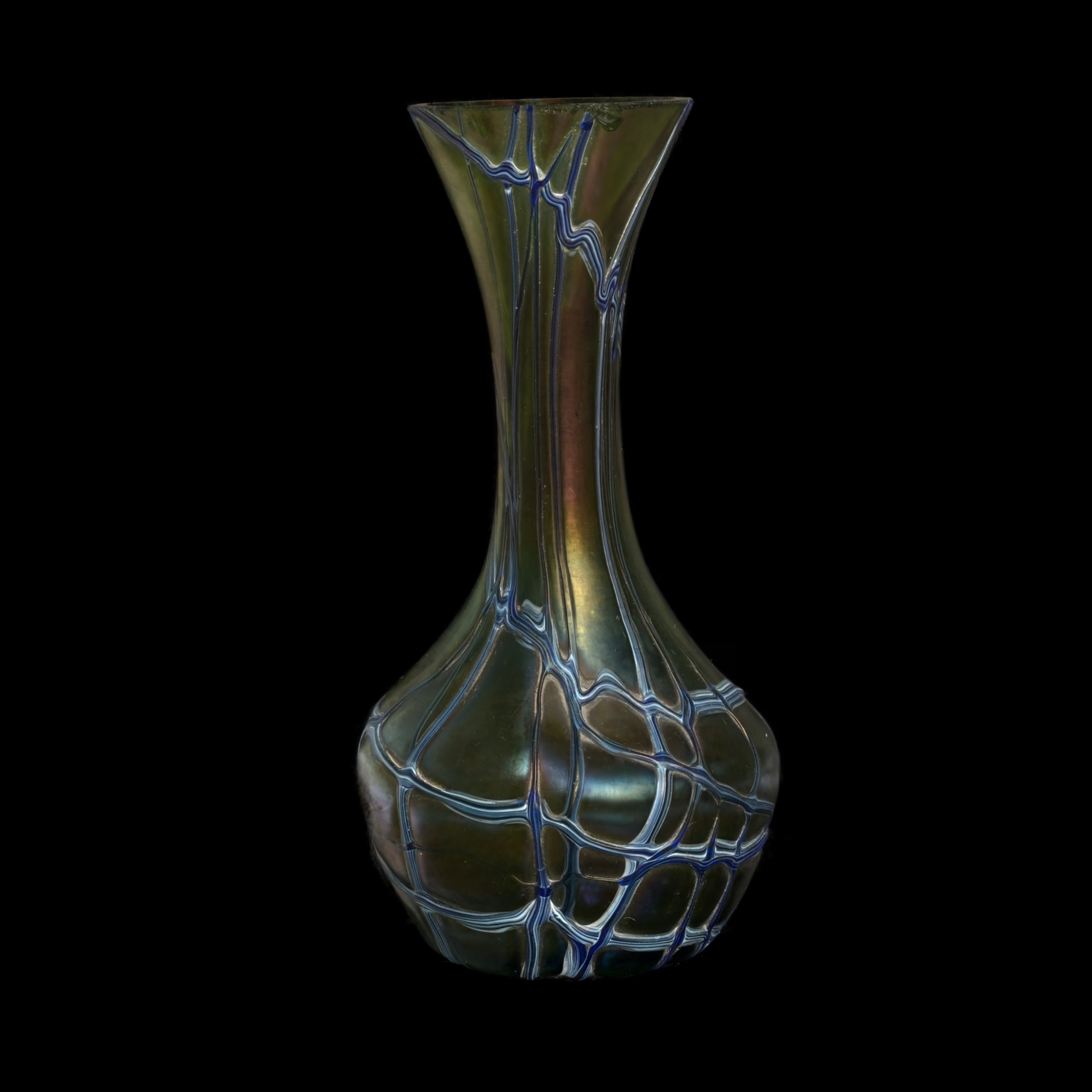
Digital Shield for Heritage: A Case Study in Developing an XR Scenario for Emergency Situations
Digital Shield for Heritage: A Case Study in Developing an XR Scenario for Emergency Situations
Culture is a component of national security: its destruction, theft, or distortion undermines a state’s resilience just as attacks on infrastructure do. That is why, in wartime conditions, Ukraine needs sustainable scenarios for applying innovative technologies to preserve, document, evacuate, and provide digital access to heritage from 3D scanning and AR tools to the integration of data into national and European registries. When the enemy seeks to destroy Ukrainian culture, museum professionals from areas of active hostilities evacuate priceless artefacts to safe storage. Thus, in wartime, Ukraine is becoming a testing ground for different approaches and practices in real time a country that offers the world practical experience in preserving heritage during a crisis.
In response to one of the sector’s greatest challenges — the evacuation of movable cultural heritage objects, we, the Odesa-based non-governmental organisation Pixelated Realities, tested new scenarios for protecting endangered heritage within the XRculture consortium. Our team represented Ukraine in this European project on the digitisation of cultural heritage through cutting-edge methods, three-dimensional modelling, and extended reality, with the Ministry of Culture officially acting as the project beneficiary in Ukraine.
The activities of Pixelated Realities within this project were carried out in coordination with Anastasiia Bondar, Deputy Minister of Culture of Ukraine for Digital Development, Digital Transformations, and Digitalisation, and Oleksandr Lashko, Director of the Department of Innovation and Digital Transformations of the Ministry of Culture of Ukraine.
The XR scenario for endangered heritage included a set of recommendations and technological developments: an MVP (minimum viable product) of a mobile AR application for scanning museum objects in emergency conditions; the development of methods for digitising collections with complex surfaces in Ukrainian and European museums; and the integration of 3D models of cultural heritage objects into the Register of the Museum Fund of Ukraine (RMFU) and the Europeana platform.
What Is XRculture and Why Does It Matter for Ukraine
The XRculture project — eXplore & Reuse 3D Cultural Heritage within the Data Space — is funded by the European Commission under the Digital Europe Programme and runs from February 2025 to July 2026. Its main goal is to enrich the shared European Data Space for Cultural Heritage (DSCH) with the highest-quality three-dimensional models, applying advanced digitisation methods based on neural networks and XR applications.
The XRculture consortium brings together ten partners from seven European countries: INCEPTION (Italy, coordinator), Fondazione Bruno Kessler – FBK (Italy), Stichting Europeana (Netherlands), IN2 Digital Innovations GmbH (Germany), Arctur (Slovenia), RDF OOD (Bulgaria), Pixelated Realities PO (Ukraine), Università Politecnica delle Marche – UNIVPM (Italy), Ministero della Cultura (Italy), and Talent S.A. (Greece).
The Ukrainian organisation worked in close cooperation with leading European institutions possessing deep expertise in 3D digitisation, artificial intelligence, XR technologies, and digital cultural heritage platforms. This matters not only in terms of receiving support, but above all from the perspective of integration into European research networks: joint development of solutions, real-world testing, and the exchange of experience make it possible to create projects that yield a genuine technological product — such as the presented mobile application for scanning heritage under emergency conditions, developed within the XR for Heritage at Risk scenario on the initiative of Pixelated Realities.
XR Scenario for Heritage at Risk
The scenario was developed under the leadership of Pixelated Realities PO, with the participation of partners IN2, ARCTUR, FBK, and UNIVPM. Its aim is to provide Ukrainian and European museum professionals, volunteers, and emergency responders with a practical tool that enables them to act quickly and confidently wherever cultural heritage comes under direct threat, whether in conflict zones (as in Ukraine during the war) or in regions exposed to natural and technological risks.
The team studied evacuation procedures aligned with the recommendations of ICCROM, Blue Shield, and new policies of the Ministry of Culture in order to define time windows for digitisation: preventively, prior to evacuation once a threat has been identified, as well as during conservation or inspection of an object in storage.
The XR scenario focuses on designing a set of technologies that, in specific conditions, configure the digitisation process more efficiently than existing methods and make it possible to capture the appearance of endangered collections and disseminate information about them within professional communities in Ukraine and across the EU.
Technological Stack of the XR Scenario
The set of technologies developed by the consortium includes:
- An AR application built on open‑source technologies that can operate offline.
- A 3D reconstruction tool that can be deployed on a server.
- A middleware protocol that enables the development of 3D viewers compatible with the Europeana data space.
- An aggregation pipeline from the Zenodo cloud repository to the data space, extracting metadata from prepared XML files and automatically adding paradata for 3D models and splats (3DGS).
- The publication of objects with 3D models and 3DGS in the public interfaces of the Register of the Museum Fund of Ukraine (RMFU) and Europeana.
Who the Tool Is For
The AR application is designed for staff of museums and institutions working with movable heritage, conservation and restoration specialists, emergency services, and volunteer organisations involved in protecting heritage during shelling, floods, or fires.
A particular emphasis is placed on small and regional museums with limited resources, for whom the tool must be easy to deploy, intuitive for non‑specialists in 3D, and more effective than paper‑based methods, which provide neither rapid response nor a full‑fledged digital copy. In frontline conditions, digital recording becomes the only realistic way to capture the state and context of objects before evacuation or conservation.
Digital inventorying of each object creates an additional layer of protection in cases of theft or illegal export: 3D models, metadata, and photo‑video documentation can be used for identification, international search, and legal proof of ownership. In this way, digital recording simultaneously serves conservation, legal protection, and diplomatic argumentation for the return of heritage.
121 Ukrainian Objects on Europeana and Splats on the RMFU
As part of XRculture, Pixelated Realities digitised and contributed to the digitisation of 62 movable cultural heritage objects from Ukraine and aggregated a total of 198 models, 121 of them from Ukraine, onto Europeana, the pan-European data space for cultural heritage.
Endangered Immovable Heritage
The first publication took place in November 2025 and marked a historic moment: three-dimensional models from the Museum of Ukrainian Victory, the Kuialnyk Catalogue, and the Odesa Municipal Museum of Personal Collections named after Bleschunov appeared on Europeana as the first 3D objects from Ukraine. In particular, the online collection included:
• The statue of the Duke de Richelieu wrapped in sandbags (Odesa)
• The Lioness of the Odesa City Garden (sculptor Auguste Caen)
• The monument to Taras Shevchenko in Odesa and its sandbagged counterpart in Kharkiv
• The Polovtsian warrior statues (Polovtsian babas), Kharkiv region
• The Northern Gate of Kherson fortress
• The Okhtyrka Museum of Local Lore, Sumy region
These models were created by the Pixelated Realities team in 2022–2023 with the support of war correspondents, who underwent specialised training and carried out photogrammetric scanning directly in the field, after which the materials were processed in Odesa.
3D Gaussian Splatting in the Register of the Museum Fund of Ukraine
The Portal of the Register of the Museum Fund of Ukraine was created by the Ministry of Culture of Ukraine as a national hub for museums, which, once the National Europeana Aggregator is established, will connect Ukrainian collections with the pan-European data space for cultural heritage. It contributes not only to the digital transformation of the sector, but also to Ukraine’s recovery after victory.
On the Portal of the Museum Fund of Ukraine, 3D models of objects created by the NGO Pixelated Realities using the 3DGS method on the basis of photogrammetric shooting are already preserved. These are digital copies that have already been integrated into the state system for recording cultural heritage and serve as a demonstration of how modern 3D reconstruction algorithms using neural networks work with surfaces that are difficult to digitise—metal, glass, fine relief, and decorative inlays. Such objects include, in particular, exhibits from the Odesa Municipal Museum of Personal Collections named after O. V. Bleschunov:
• “Gulyaka” (Turkmen chest ornament, copper alloy and coloured glass, with a complex multi-layered surface texture)
• “Yenselik” (traditional jewellery with a delicate metal framework and numerous small inlays)
• “Shelpe” (a pendant with a multi-component structure combining metal and glass elements)
• “Tumar” (an amulet-container with pronounced relief decor, mixed materials, and complex transitions of form)
• “Dagdan” (a massive element of a traditional ornament combining metal plates and various inlays).
For these objects, the 3DGS rendering method is applied after photogrammetry as a way to obtain a maximally photorealistic 3D reconstruction.
In the classical photogrammetric reconstruction method, the model is generated from depth maps of pre-aligned stereo pairs (SfM/MVS), and for shiny or transparent objects this creates conditions that are impossible for the meshing algorithm. Shiny, metallic, and transparent surfaces are therefore called non-collaborative, and their effective scanning typically requires matting sprays and chemical compounds. However, not all museum objects can be coated with such sprays, and a matted surface does not convey the internal properties of transparent and translucent materials during scanning.
3D Gaussian Splatting is based on the first stage of photogrammetry, Structure from Motion, which uses a sparse point cloud obtained after triangulation and a camera pose matrix in space. These provide the neural network with the information it needs to train, from photographs, a 3D representation composed of small coloured ellipsoids—splats—and to enable the scanning of non-collaborative surfaces without the use of sprays or chemical agents.
For icons scanned using 3DGS, high-quality textured 3D models are also created, including:
• The icon “Dormition of the Mother of God” – first half of the 19th century, executed in the tradition of Lipovan painting of the Lower Danube region (Odesa oblast, Ukraine), with characteristic saturated colours and a strong focus on the centre of the composition.
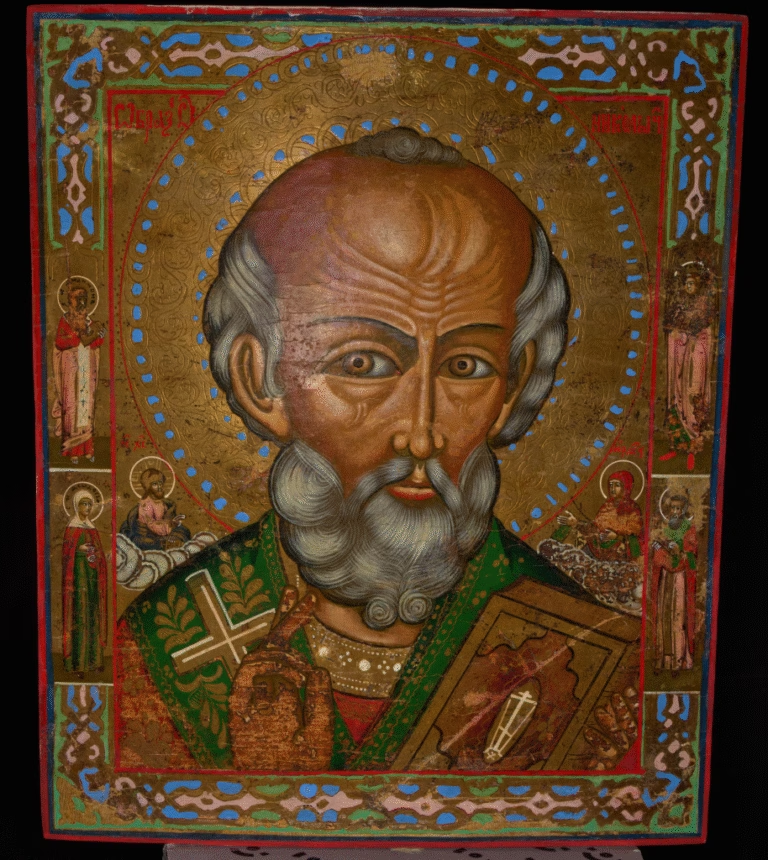
• The icon “Saint Nicholas ‘Reversing Misfortune’” – late 19th century, executed in the tradition of Lipovan painting of the Lower Danube region (Odesa oblast, Ukraine), with characteristically layered paint, a darkened oil ground, and complex surface texture.
• The icon “Mother of God of Okhtyrka” – late 18th – early 19th century, patron of the Sumy Hussar Regiment, Ukrainian variant, Ukraine (Sumy oblast), with finely rendered facial features and clothing and pronounced craquelure.
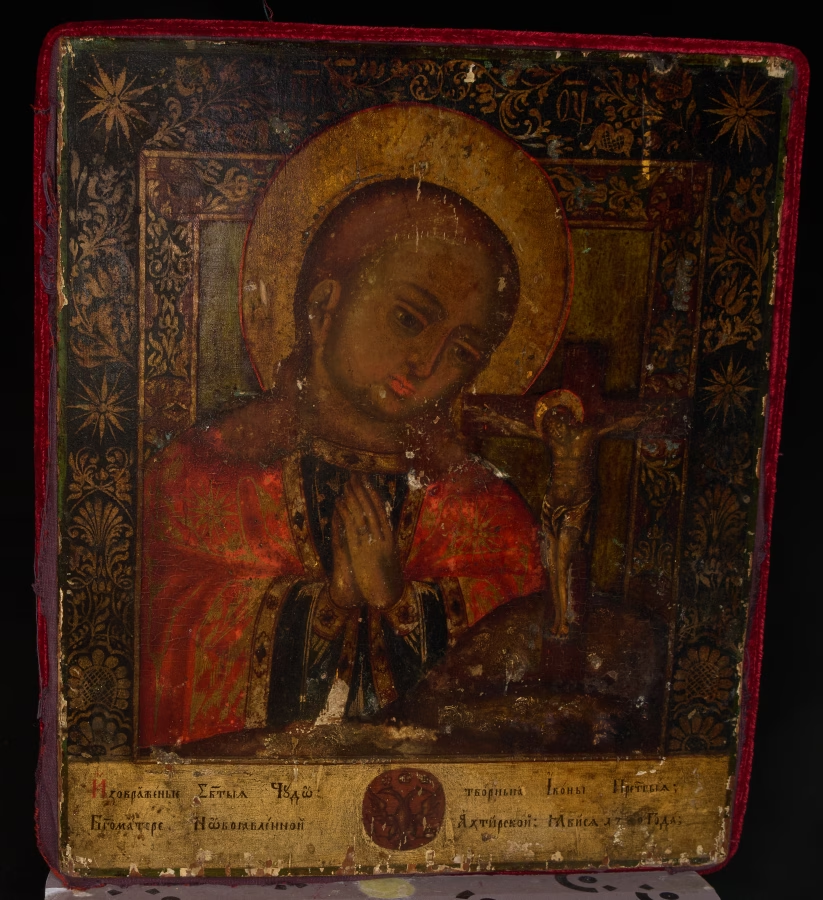
For icons, 3D models are important not only from the perspective of visualisation, but also for restoration and protection: the digital layer makes it possible to document the condition of the painting, cracks, paint losses, and deformations of the support, and to use these data as a digital “point of departure” for subsequent interventions.
Scanning Glass at the Verona Archaeological Museum
Within the XRculture project, Pixelated Realities PO acts not only as the Ukrainian partner of the consortium, but also as the team that takes on the most challenging 3D digitisation cases. Their work is simultaneously aimed at preserving Ukrainian heritage and expanding the ability of all museums to work with “unfriendly” materials: glass, metal, composite surfaces, icons, and objects with high optical complexity.
The team succeeded in scanning transparent glass. At the end of March 2026, they carried out 3D digitisation of a collection of Roman glass at the Museo Archeologico Nazionale di Verona (Italy). The campaign was led by Fedir Boitsov. Seventy‑seven unique artefacts from the 1st–3rd centuries AD were captured: balsamaria, amphorae, tumblers, plates, bottles, jugs, lids — thin‑walled, transparent, with relief and pressed decoration, in shades ranging from bluish to yellowish.
To overcome the challenges of scanning non‑collaborative surfaces and transparent objects, the team developed a customised mobile rig:
— a turntable and camera tripod;
• Continuous video lighting that evenly illuminates the glass and minimises stray reflections in the photographic material
• An automatic turntable with ultra‑clear plexiglass, which allows the object not to be turned over in order to capture its underside – crucial for fragile artefacts
• A tall vertical rail on a 2‑metre stand with a cord‑and‑counterweight system for smooth, repeatable vertical passes of the camera
In combination with photogrammetry and 3D Gaussian Splatting, this rig made it possible to obtain detailed digital models even of the smallest glass objects, which will be presented on Europeana as an example of how non‑collaborative surfaces can be successfully digitised.
Glass and Icons at the Bleschunov Museum
In Odesa, the team digitised a collection of icons and glass objects from the Odesa Municipal Museum of Personal Collections named after O. V. Bleschunov. They created 3D models of 10 icons and 20 glass artefacts selected specifically because of the complex properties of their surfaces: transparency, gloss, and the combination of different materials.
For these objects, in addition to photogrammetry and 3D Gaussian Splatting, the team developed a new semi‑automated point‑cloud cleaning method based on Houdini, which reduces post‑processing to approximately 10 minutes per object – a critically important figure where time and resources are limited.
From a technological standpoint, this means:
• The ability to systematically digitise transparent and shiny objects (glass vessels, jewellery, metal details) and make them accessible to researchers and the wider public
• The capacity to create meshes for the most valuable exhibits, which can subsequently be used for 3D printing and milling – for inclusive displays (tactile replicas for work with children, blind and visually impaired visitors), as well as for restoration processes.
What This Means for Ukraine
The results of the XRculture project directly strengthen state cultural policy and take into account the strategic interests of the Ministry of Culture of Ukraine.
First, the integration of Ukrainian 3D models into Europeana and the synchronisation of these data with objects in the Register of the Museum Fund of Ukraine make Ukrainian heritage visible and protected at a level that is financially and technologically difficult to achieve using only national resources.
For Ukraine, this is a tool for:
• Proving ownership of objects that may be stolen, removed, or subjected to dubious restitution schemes
• Legal and diplomatic argumentation in international proceedings (as in the case of the Scythian gold, where a single state register and digital records become evidence of the exhibits’ belonging to Ukraine).
Second, Ukraine’s participation through XRculture in creating the first Ukrainian 3D models on Europeana is both a symbolic and a practical gesture, showing that Ukrainian culture is an integral part of the shared European cultural space. These are not merely “digital files”, but:
• A signal to EU partners that Ukrainian institutions are capable of working to the highest technical standards
• An argument in favour of further investment in the digital infrastructure of culture and of Ukraine’s accession to long‑term European initiatives in the field of 3D digitisation.
Third, the development of the XR scenario Heritage at Risk means:
• The existence of a piloted, proven technological scenario (3D Gaussian Splatting, mobile digitisation rigs, offline application) that can be scaled up in cooperation with museums across the country
• The ability to build national digital policy in the heritage sector in synchrony with already recognised international standards, platforms, and IT development protocols
• A stronger position for Ukraine in European discussions on heritage protection under conditions of war, climate change, and crises – with the argument: “we are not only asking for help; we are sharing solutions that work.”
In summary, international projects are not only grants as a source of funding, but also access to cutting‑edge technologies and expert communities; the opportunity to test one’s solutions on real cases – from museums in frontline cities to major European institutions; and a chance to secure Ukraine’s presence in the shared digital space.


